Tuesday, July 21, 2015

Pope Francis's Encyclical "Laudato Si'" - Part 2

In Part 1 of this series of posts, I talked about Pope Francis's 2015 encyclical, "Laudato Si'" ("Praise Be to You"). I referred to the passage:

How wonderful is the certainty that each human life is not adrift in the midst of hopeless chaos, in a world ruled by pure chance or endlessly recurring cycles!

That passage suggested to me that the Pope knows and cares about the modern sciences of chaos and complexity. The theories developed by those sciences hold that many natural systems are both dynamically changing (no surprise there) and mathematically quite nonlinear. Nonlinearity means that changes in the state of the system are ultimately unpredictable (chaos) and/or generative of brand new varieties of order (complex adaptive systems).

Complex adaptive systems produce ever greater complexity (the varied types of elements within the system) and yet surprising order and stability (a feature which chaotic systems lack). Life on Earth evolves as a complex adaptive system. Our species is here partly because of the self-organizing dynamics of such systems, not just because of Darwinian natural selection.
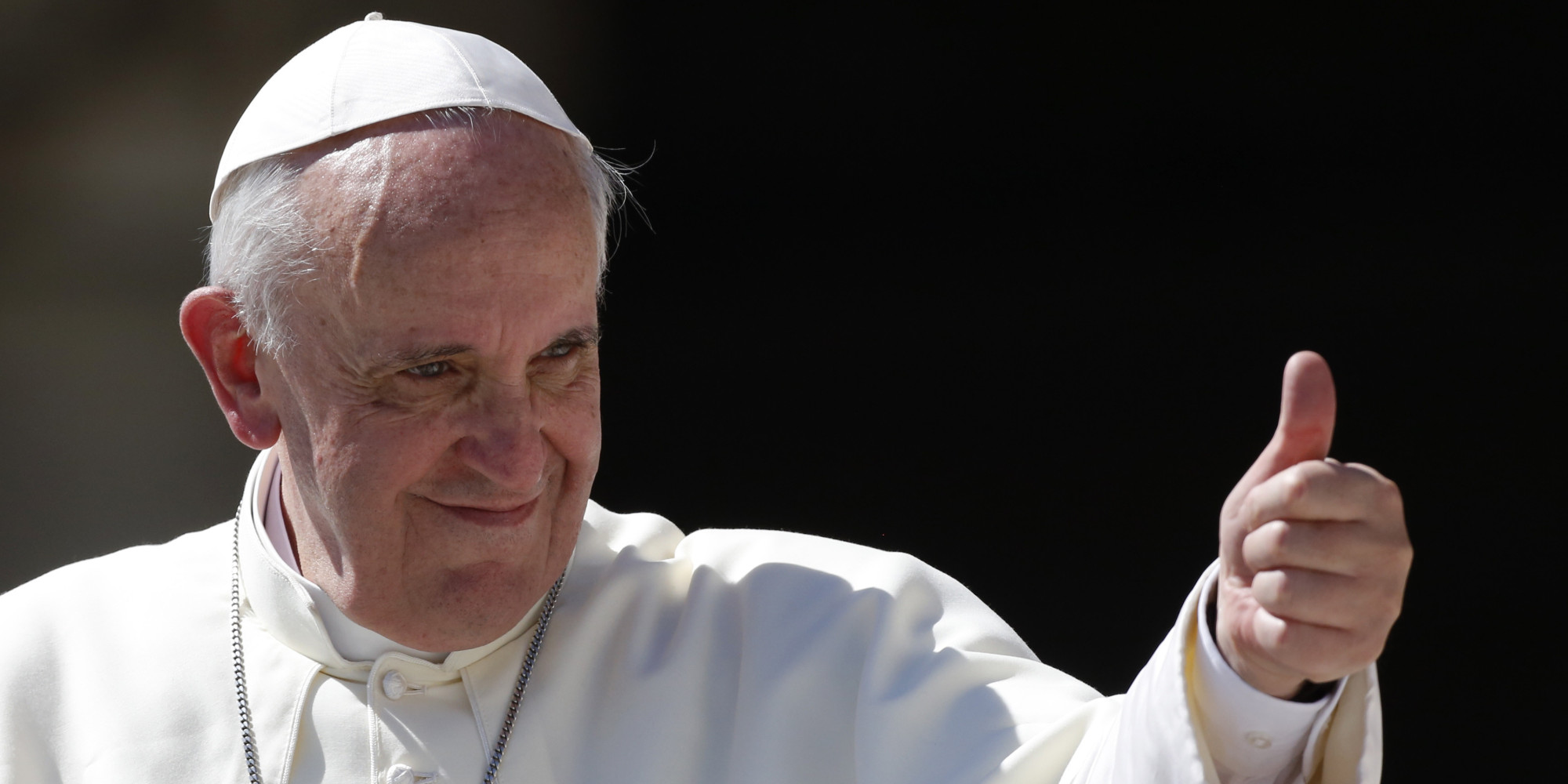
Pope Francis
That's a conclusion scientists of complexity can reach by studying "nature" and modeling it on computers. But Pope Francis points out that "nature" is a smaller and more limited concept than "creation," the handiwork of God. The theology of the Catholic Church, like that of many other churches and religions, is concerned with that bigger picture — while still affirming that scientific inquiry is a legitimate pursuit, of course.

At first blush, "Laudato Si'" impresses many readers as a document that is very, very far left, environmentally speaking. It is quite easy to conclude that Francis wants national governments and international bodies to take full charge in the fight against climate change and global warming. But I have to disagree with such a simplistic reading of the encyclical. I think the Pope is championing a much more nuanced approach than just ham-fisted top-down policies issued from the "commanding heights" of governments and international institutions.

* * *

My reason has to do with how complex adaptive systems are to be understood.


In the diagram above, the "agents" down below interact in a regular, rule-based way. As a result, those agents, taken as a group, generate a stable, orderly "pattern" that characterizes the system as a whole. For example, take a flock of birds:


The flock holds together in a stable arrangement (the "pattern") even as its shape shifts continuously as the flock flies along. The individual birds (the "agents") instinctively follow a simple rule (a "regularity") that says to maintain a set distance from each neighboring bird. Following that simple rule allows flocking to occur. The flock as a whole is a complex adaptive system, in that its changing shape somehow "knows" how to adapt to changing conditions such as the wind's direction and speed.

The point here is that complex, self-organizing systems such as the one shown in the earlier diagram have both upward-pointing arrows and downward-pointing arrows. The former emerge from the interacting of the agents as they conform to their rule-based regularities. The latter represent "feedback," originating from the overall pattern that is being generated, that is sent on back down to the agents — as when each member of a flock of birds seems to "know" how to adjust to a change in wind direction.

If conservatives' criticisms of "Laudato Si'" that it is some kind of radically leftist document are correct, then the implication is that the Pope is relying on just the downward-pointing arrows — supporting top-down approaches alone — in dealing with climate change. He accordingly must be rejecting solutions that endorse the bottom-up regularities of, specifically, market-driven capitalism.

* * *

This seems to be the gripe that New York Times columnist David Brooks has with "Laudato Si'." In my view of the encyclical, the Pope is saying in this encyclical that we Christians in particular, but also everyone else on Earth, have a spiritual and a moral duty to protect the planet. Scientific and practical considerations which the encyclical spells out dictate that we can't live up to that duty if we let our standard deference to free-market capitalism and the rights of private property trump ecological exigencies.

David Brooks
Mr. Brooks is often finely attuned to such spiritual and moral considerations. But in this case he challenges the Pope almost out of hand, writing: "Hardest to accept ... is the moral premise implied throughout the encyclical: that the only legitimate human relationships are based on compassion, harmony and love, and that arrangements based on self-interest and competition are inherently destructive."

But that's not quite what Pope Francis says. He doesn't actually claim that self-interest and competition are fundamentally destructive. He affirms, in fact, the value of private economic interests. But he also subordinates those interests to what he — echoing Pope (now Saint) John Paul II — calls "a social mortgage on all private property." Francis writes in paragraph 93, section VI of "Laudato Si'":

The principle of the subordination of private property to the universal destination of [human] goods, and thus the right of everyone to their use, is a golden rule of social conduct and [per John Paul II's Encyclical Letter 'Laborem Exercens'] 'the first principle of the whole ethical and social order'. The Christian tradition has never recognized the right to private property as absolute or inviolable, and has stressed the social purpose of all forms of private property. Saint John Paul II forcefully reaffirmed this teaching, stating [in his Encyclical Letter 'Centesimus Annus'] that 'God gave the earth to the whole human race for the sustenance of all its members, without excluding or favouring anyone'. These are strong words. He noted [in his Encyclical Letter 'Sollicitudo Rei Socialis'] that 'a type of development which did not respect and promote human rights – personal and social, economic and political, including the rights of nations and of peoples – would not be really worthy of man'. He clearly explained [in his 1979 'Address to Indigenous and Rural People'] that 'the Church does indeed defend the legitimate right to private property, but she also teaches no less clearly that there is always a social mortgage on all private property, in order that goods may serve the general purpose that God gave them'.

Accordingly, in certain situations "compassion, harmony and love" ought in fact to trump "arrangements based on self-interest and competition." This is what Francis is maintaining. And today's clear and present threat of human-caused global warming is one of those situations. That would seem to be a more nuanced summary of Francis's position than the one David Brooks posits.

The Pope's "social mortgage" approach to the matter is not, as Mr. Brooks claims, "relentlessly negative ... when describing institutions in which people compete for political power or economic gain." It is instead quite realistic, I'd say, given that in the eyes of our very real Creator God no person or people ought to be excluded from sharing in our planet's abundance.

The Pope would accordingly have governments and international institutions constrain free markets as needed to fight global warming and to keep developing nations with their less-well-off populations from suffering the brunt of its effects.

* * *

Buzzwords: The economy
as complex adaptive
system (click
to enlarge)
But what about the possibility of harnessing market forces that embody the "regularities" of supply and demand? Those are the forces, after all, that manifestly influence the behavior of "agents" (buyers and sellers) at the bottom level of a market-based economy, when the economy is seen as one type of complex adaptive system. What about shaping the operation of those forces as a way of combatting global warming? Might Pope Francis endorse such a possibility? Should David Brooks and other conservatives approve of "Laudato Si'," when cast in that light?

This post is already too long, though. I'll talk about those questions in my next post ...


Friday, July 17, 2015

Pope Francis's Encyclical "Laudato Si'" - Part 1

Pope Francis's 2015 encyclical "Laudato Si'" ("Praise Be to You") is a plea for people of good will — not just Catholics like me — to take climate change seriously as a global threat that calls for all of us to change our ways. The steady emission into the atmosphere of carbon dioxide and other greenhouse gases that are born of burning fossil fuels has to abate.

The Pope ties concern for the ecology of the Earth with religion's traditional concern for social justice: a preferential option for the poor. The poorer nations of the world are at once the most likely to suffer the harsh effects of global warming and the least responsible for creating the impending climate disaster in the first place.

We need accordingly to rein in our tendency in the richer nations to use the gifts of nature sheerly for generating wealth, as if Mother Nature were just a thing to be exploited by the few who are lucky enough to reap her economic benefits.

In the course of explaining the Catholic Church's stand against pillaging the environment, Pope Francis takes up the theology of creation rooted in the very first story of the Bible:

"In the first creation account in the Book of Genesis, God’s plan includes creating humanity. After the creation of man and woman, 'God saw everything that he had made, and behold it was very good' (Gen 1:31)."

Men and women are deemed "very good" — hence, social justice is a must. Everything that God made is likewise called "very good" — hence our duty to preserve and protect the Earth.

It is in the course of his discussion of creation theology that Francis says something I find quite interesting:

"How wonderful is the certainty that each human life is not adrift in the midst of hopeless chaos, in a world ruled by pure chance or endlessly recurring cycles!"

That sentence suggests certain theological implications of the recent insights of science into "chaos" and "complexity."

Graph illustrating
the "butterfly effect" in
chaotic systems actually
can look like a butterfly
Chaos theory has come to the fore in the last half century, following the discovery that the unpredictability of weather — and hence ultimately of the Earth's climate — stems from infinitesimal differences in "initial conditions." This is the "butterfly effect." Due to the mathematics of chaos, illustrated by the graph at above-left, a tiny butterfly flapping its wings in Rio can in theory produce a tornado in Reno. Accordingly, the computers we use to model such things can't predict weather beyond a few days into the future.

That's because weather is one of nature's many "nonlinear dynamical systems": basically, changes occur in the state of any nonlinear dynamical system according to mathematical functions that do not graph as a straight line. These changes that occur can be unpredictable in the long run. "Chaotic" instances of nonlinear dynamical systems — not all such systems are chaotic and unpredictable — diverge so much in their states' unfolding trajectories that beyond a short period of time their future simply cannot be known in advance.

"Chaotic systems are predictable for a while," says Wikipedia's article on chaos theory, "and then 'appear' to become random." Such systems, whether natural, manmade, or purely mathematical, exhibit what scientists today refer to as "chaos." This means that the systems are not, strictly speaking, "random"; their behavior is "deterministic." If we could but know their initial conditions with perfect exactitude, we could predict their successive states with equal exactitude from the present moment right up until the end of time.

When Pope Francis speaks of "endlessly recurring cycles," on the other hand, he is talking about the opposite of chaos: order. Science recognizes two types of order in the panoply of conceivable behavior patterns of nonlinear dynamical systems. One type of orderly behavior is what happens when a marble released along the inner surface of a coffee cup, near its rim, ultimately comes to rest. After rolling down and then back up the inside of the cup and repeating that behavior for quite a while, the marble ultimately sits motionless at the cup's bottom.

The second type of order is that of "endlessly recurring cycles." The Earth orbits the Sun each year in just such a seemingly endless cycle.

So we have orderly nonlinear dynamical systems, and we have chaotic ones. Out of the scientific study of chaotic behavior has more recently emerged a companion notion, the "theory of complexity." Complexity, in this usage, has to do with nonlinear dynamical systems that are capable of "self-organization."

A flock of birds is
a self-organizing system;
the flock is an "emergent property"
of individual birds keeping a set distance
from their immediate neighbors
We typically think that organization can be imposed on a network of interacting elements that make up a nonlinear dynamical system strictly "from the top down," as when a strong leader imposes order on a gaggle of squabbling factions. Yet graceful order quite surprisingly can emerge "from the bottom up." The question of how this can happen, and can combine and interact with top-down order, is the province of complexity theory.

Scientists studying complexity have discovered that such self-organized behavior takes place at the "edge of chaos." According to M. Mitchell Waldrop in his book Complexity: The Emerging Science at the Edge of Order and Chaos, the edge of chaos is "the constantly shifting battle zone between stagnation and anarchy, the one place where a complex system can be spontaneous, adaptive, and alive" (p. 12).

Nonlinear dynamical systems whose behavior exhibits spontaneous self-organization can be impelled from that beneficent edge over into the realm of outright chaos — it can happen when a Brazilian butterfly innocently flaps its wings — but can then, all by themselves, move out of chaos back over into the orderly regime. When that happens, the result is not always a return to the old, previously established order. It is rather the generation of a newer, more elaborate order. There is a concomitant gain in the system's "complexity" — the diversity or elaborateness of its interacting elements. This is, then, one meaning of the term "self-organized complexity."

Self-organized complexity is accordingly a third, quite unexpected kind of order. The order that arises in such a system is completely spontaneous. It is not static, as with a marble that eventually comes to rest at the bottom of a coffee cup, and it is not cyclical, as with a planet endlessly orbiting a star.

The human species, complexity science says, is a product of just such a process of spontaneous self-organization. That is, the evolution of life on Earth is not solely a matter of random DNA mutations sifted by Darwinian natural selection. There is something else going on. Earth's life is a "complex adaptive system" capable of generating, then preserving, self-organized, elegantly graceful, completely novel order.

So when Pope Francis says we are creatures of "infinite dignity" who are "made in God's image and likeness," and when in the same breath he says that "that each human life is not adrift in the midst of hopeless chaos, in a world ruled by pure chance or endlessly recurring cycles," he seems to be affirming insights of the recent sciences of chaos and complexity into the evolution of life on Earth. At the same time, he rejects the assumption many people make that Darwin's theory of evolution implies that no Creator God exists.

In future posts, I will talk more about how complexity theory furnishes a useful lens through which Pope Francis's "Laudato Si'" may be viewed.


Tuesday, June 22, 2010

The Dirty Truth about Plug-in Hybrids

The Dirty Truth about Plug-in Hybrids is an interactive version of an article in the July 2010 issue of Scientific American. Here's a key graphic from it (click to enlarge):


The article is about how soon-to-come plug-in autos such as the Nissan Leaf and Chevy Volt may put more carbon in the atmosphere than regular hybrids like the Toyota Prius, depending on what region of the country it is operated in. The plug-ins will either be all-electric (the Leaf) or will have gasoline-powered motors that start up to help charge their battery in a pinch (the Volt). Both types will have to be recharged, mainly or exclusively, by plugging into a power outlet in the owner's garage, though the Volt and other "hybrid" plug-ins can add to their per-charge range by burning gasoline in their gas-powered motors as needed.

At first blush, the less gasoline the plug-ins consume — those that consume any at all, that is — the cleaner and greener they would seem. An all-electric would seem greenest of all. But wait, says the article. Drawing electric power can cause more carbon pollution at the electric power generating facility than the cars save by burning less (or no) gas.

The Scientific American article says that there is wide variation among the regions of the United States as to the mix of energy sources used to make electricity: coal, natural gas, oil, renewables, etc. Depending on the mix, driving a plug-in in a particular region may actually put more carbon in the air than an entirely gasoline-powered hybrid like the Prius.

The same is true with respect to oil consumption, in that oil, or petroleum, is of course the source of gasoline. Even though a plug-in nominally consumes little or no gasoline, in regions where petroleum is used to generate electricity, the saving is again problematic.

As it turns out (see the graphic above) plug-ins do save on oil consumption in every region, vis-à-vis standard hybrids, but the saving is very slight in one particularly populous region: New York.

Meanwhile, the plug-ins' comparative carbon "footprint" varies from one region to the next. In no region is the carbon saving huge for either type of plug-in, but then again in no region do the plug-ins, of either type, put hugely more carbon in the air, either. In two regions, the Upper Midwest and the Mid-Atlantic, hybrid plug-ins help reduce carbon emissions, while all-electrics add to emissions. But in other regions, all-electrics are preferable to hybrid plug-ins, and in most of these, both are preferable to standard hybrids that don't plug in to electrical power sources at any time.

Of course, we can expect the mix of energy sources from which electricity is derived to change over the next several years. If climate-change legislation, via a carbon tax or a cap-and-trade system, puts a price on carbon, then electricity generators will gradually switch away from oil, coal, and natural gas to (say) wind farms and nuclear reactors. That would redraw the Scientific American map over time. A Leaf bought in 2011 may get a whole lot greener by, say, 2020.

Be that as it may, we all need to be aware that there is no such thing as a zero-emission car — not now. Decades from now, maybe.

Wednesday, December 9, 2009

Sarah Palin on Climate-gate

Former Alaska governor and GOP vice-presidential candidate Sarah Palin writes, in "Copenhagen's political science" on the op-ed page of today's The Washington Post:

With the publication of damaging e-mails from a climate research center in Britain, the radical environmental movement appears to face a tipping point. The revelation of appalling actions by so-called climate change experts allows the American public to finally understand the concerns so many of us have articulated on this issue.

Much as I hate to admit it, she makes a valid point in her op-ed: the recent publication of embarrassing e-mails filched from the Climatic Research Unit of the University of East Anglia in Britain is a game changer. This so-called "climate-gate" scandal undermines my own personal confidence in scientific projections about imminent global warming. It should undermine President Obama's as well, I think — unfortunately, just as the Copenhagen conference on climate change opens.

Let me be clear: even if global warming is a figment, I believe we should still transition to renewable energy sources as fast as possible. But the reason we ought to do so is that we need to develop sources of energy that (eventually) will be abundant and ultra-cheap to harvest: solar, wind, geothermal, and the like. With those resources fully in play — the technological hurdles of harvesting them having been overcome — America will have energy running out of its ears.

Our economy runs on energy, right? When clean electrons become cheap enough to replace dirty electrons that derive from coal, oil, gas, etc., we'll have the basis for hugely enlarged economic productivity. Everyone in America will benefit — once the industries that produce all the dirty electrons finally wither and die.

Ms. Palin misses that point: there are other compelling reasons, besides climate change, to go green, energy-wise.

Still and all, the debate has been framed otherwise. Efforts to reduce the greenhouse emissions of this country and others have been justified as prudential reactions to the threat of global warming. If that threat has been exaggerated by scientists' misfeasance — and it looks like it has — where does that leave us?

If key scientists have interfered with the customary avenues of peer review — and it looks like they have — doesn't that raise legitimate doubts about today's orthodoxy concerning imminent climate change?

I think it does.

Wednesday, August 19, 2009

The Straw That Stirs the Drink (Still Off-Topic)

Washington Post reporter Alec MacGillis wrote "A Guide to the Health Care Fight" for the Sunday Post's Outlook section on August 16, 2009. In it he said:
Dominating the whole [health care] debate is the question of whether to include a government-run insurance plan on the exchange. Proponents say such a measure — included in the House bill and the Senate health committee bill — would provide the uninsured with a guaranteed high-quality plan, in case insurers still try to game the rules to deny coverage or payments. They say it would also restrain the overall growth in costs. A low-priced competitor, the logic goes, would drive insurers to pressure doctors to deliver the most cost-effective care.

In today's newspaper, "Debate's Path Caught Obama by Surprise: Public Option Wasn't Intended as Major Focus" appears on the front page. It quotes "a senior White House adviser, who spoke on the condition of anonymity," who said:
"We've gotten to this point where health care on the left is determined by the breadth of the public option. I don't understand how that has become the measure of whether what we achieve is health-care reform."

Let me, then, summarize the whole pro-public plan position: I'd say there are two main reasons why the public option is indeed "the measure of ... health-care reform." One, it will keep private insurers from gaming the system. Two, it will "restrain the overall growth in costs."

I consider the second reason even more important than the first. To "drive insurers to pressure doctors to deliver the most cost-effective care" is to compel the restructuring of how health care is delivered in this country. Not how it is insured, necessarily, but how it is delivered. Today, doctors and other sources of health care charge for services rendered. Another MRI, another charge. What needs to happen is for providers to work together, avoid unnecessary, duplicative procedures, and get paid for results, not for services.

President Obama has said he won't insist on a public option, i.e., a nonprofit, government-run health insurer. He isn't "drawing a line in the sand" about a public option. He favors it but he has also said, "If there is a way of getting this done where we're driving down costs and people are getting health insurance at an affordable rate and have choice of doctor, have flexibility in terms of their plans, and we could do that entirely through the market, I'd be happy to do it that way."

Fine, but without a public option or a close substitute, driving down costs is problematic. So what might be a close substitute? MacGillis, in the Post:
To get Republican votes, the Senate Finance Committee's bill is likely to include member-owned cooperatives instead of a public option, though critics say those would lack competitive clout.

And, according to today's front-page story:
Republicans signaled Tuesday that dropping the public option would not garner additional GOP backing. Jon Kyl (Ariz.), the second-ranking Senate Republican leader, criticized an alternative idea of creating a private insurance cooperative, calling it a "Trojan horse" that was effectively the same as the public option.

"It doesn't matter what you call it, they want it to accomplish something Republicans are opposed to," he said.

Kyl's comments came as other conservative Republicans joined in to bash the co-ops idea. Rep. Tom Price (Ga.) said, "A co-op that is simply another name for a public option, or government-run plan, will be rejected by the American people."

Yesterday morning's Post juxtaposed these two articles: "Some Key Democrats Say Public Option is Essential to Health-Care Reform" and "Health Cooperatives Gain Backing as Alternative to Public Option." According to the latter, health co-ops might not even make it off the ground, assuming the eventual reform legislation authorizes them.

That's important, but what's truly key is that co-ops, if passed, might lack enough marketplace clout to drive health care into a more efficient delivery mode. The public option would do just that. My continuing attitude is that the public option amounts to the Reggie Jackson of health insurance reform: it's the straw that stirs the drink.

Sunday, August 16, 2009

Off-Topic Yet Again: Mr. President, Please Don't Kill the Public Option!

Today I sent the following message to President Obama at the White House:

Re: Keep the public plan in health insurance reform, please

Dear Mr. President,

It's Sunday, Aug. 16, 2009, and as I was sipping my morning coffee I was pondering whether to donate money to Organizing for America in support of your health care reform program. I thought I'd first send a message to you saying I feared that as soon as I did so, you would back away from the public option which I feel is a sine qua non of reform.

Before I composed that message, I signed on to Yahoo! and learned that your Health and Human Services Secretary, Kathleen Sebelius, has on this very day, on CNN's "State of the Union," floated backing away from public insurance.

I'm oh-so-strongly opposed to that. As John Holahan and Linda J. Blumberg of the Urban Institute's Health Policy Center wrote in "Is the Public Plan Option a Necessary Part of Health Reform?":

"Due to the controversial nature of the public plan option, policymakers are considering alternatives that could be considered as possible compromises between liberals and conservatives. These alternatives include reducing the market power or ratesetting power of the public plan or creating nongovernmental, nonprofit entities that could produce their own insurance plans with negotiated provider payment rates. While these options are likely to have political appeal, it is important to recognize that the cost-containment potential of a public plan rests fully in its ability to leverage the power of the federal government as health care purchaser to encourage provider participation and reduce prevailing payment rates. Without taking advantage of that strength, the cost-containment potential of the public plan option or an alternative would be tremendously weakened."

Citing Mr. Holahan and Ms. Blumberg, a recent Washington Post article (Friday, August 7, 2009), "Democrats Weigh the Cost of Public Insurance," makes the point that:

" ... a public plan is essential to fiscal responsibility in a country where health-care spending has soared to $2.4 trillion per year. A public option such as that proposed by House Democrats, with prices initially set at 5 percent above Medicare rates but well below private insurer rates, would inject competition into markets that are now oligopolies: An American Medical Association study found that a single insurer controls more than half the market in 16 states and a third of it in 38 states.

"This competition, the thinking goes, would drive insurers to demand that medical providers find more cost-effective ways to deliver care, leading to innovations and the spread of well-integrated networks of salaried physicians in place of the costly fee-for-service approach that predominates today.

"As it stands, insurers can pass along rising medical costs in the form of higher premiums. But with a public option in the mix, providers would work with insurers to lower costs to keep the private insurers from going out of business. Providers would probably have little choice but to accept the public option but would not want it to gain too much of the market. Medicare does not offer this competitive dynamic because it covers only the elderly. ...

"The economists in this camp say a public option would not underprice insurers so aggressively as to drive them out of business — political pressures from medical providers would restrain Congress just as it is restrained today from limiting Medicare rates too much. Private insurers could still compete on service and would benefit from their deep ties in local markets.

"But the public plan would produce savings, [economists like Mr. Holahan and Ms. Blumberg] say. The Congressional Budget Office estimates that the House's public option would save $150 billion over the first 10 years. Without it, these economists say, the government would have to save money by cutting subsidies to the point that people would be unable to afford the coverage that they're required to buy."

Secretary Sebelius said on CNN that public insurance is "not the essential element." Mr. Holahan and Ms. Blumberg suggest that it is. I think Mr. Holahan and Ms. Blumberg are right, and Secretary Sebelius is wrong. For your administration to cave in on the public option is, I believe, pandering to the political right in hopes of getting a half-a-loaf reform bill passed ... and it will keep me from making that donation to Organizing for America. It will also end my erstwhile tendency to give you my strong, unwavering support in the various fights, such as that on climate change, that lie ahead on today's political agenda.

You can get my unwavering support back, Mr. President, but only if you back away from today's backing away, so to speak.

If you, like me, support health insurance reform that includes a government-run public option, I urge you, too, to write to President Obama at the White House and tell him so.

Wednesday, August 12, 2009

Still Off-Topic: Model Health Reform Public Plan on FEHB?

In Admittedly a Bit Off-Topic: A Public Plan, or Not? I strayed off the main topic of this blog: the environment and climate change legislation. Now, more of the same. My rationale is that the health-reform debate is so intense right now that no one is thinking about climate legislation.

The debate over health care reform/health insurance reform has indeed turned ugly. The "continental divide" between supporters and opponents of reform has at its very apex the question of a public option for health insurance. This option would, depending on who you ask, either open up Medicare, as presently constituted, to younger people or create a new, separate, government-run insurer that is something like (but not exactly like) Medicare.

The latter possibility is the one I discussed in the post I just mentioned. My assumptions were that premium rates would be set halfway between Medicare and private plans, and only people in certain categories would be allowed to join. Restricted access and rates above Medicare's would keep the plan from swamping the private insurance market, while allowing some competition between the public plan and private insurers. That competition would wind up putting pressure on health care providers, via private insurers, to restructure away from the omnipresent fee-for-service model that now drives health care costs skyward.


However, I shouldn't have so casually ignored another model that has been proposed for the public option: opening up the current Federal Employees Health Benefits Program to one and all.

FEHB, as the program name is abbreviated, provides yours truly, a retired federal employee, with health coverage. I am quite happy with the health insurance I get via FEHB, which comes from CareFirst BlueCross BlueShield of Maryland, a so-called Preferred Provider Organization or PPO. (A PPO is apparently a sort of fee-for-service plan that saves money by directing me to particular health care providers that have signed up to charge less.) My locally provided insurance coverage is, in turn, part of a national umbrella plan called FEP Blue (for "Federal Employee Program - BlueCross BlueShield").

If I stopped liking that coverage, each fall at "open season" I would be able to change. I could, if I liked, choose among straight fee-for-service plans, PPOs like the one I have, or health maintenance organizations (HMOs). There are, as well, "High Deductible Health Plans," "Consumer-Driven Health Plans,"Health Reimbursement Arrangements," and "Health Savings Accounts." Some of the options open to me are nationwide, and others are specific to my home state, Maryland.

Apparently, some of the political leaders who have spoken in favor of a public option have suggested opening up the Federal Employee Health Benefits program as one way to do it. According to this blog post, Senator Max Baucus (D-Montana), who heads the crucial Finance Committee, favors "keeping the public option 'on the table'," and FEHB expansion is one way he has spoken of for doing it.

It looks as if a great many of those who want a Medicare-style public option hate the idea of using an FEHB expansion in its stead. The blog post I just mentioned is a case in point, as are this post and this. The complaints are that FEHB is too expensive, since "100,000 federal workers don’t participate because they can’t pay the price"; FEHB just repackages private insurance, with its high overhead expenses and profit margins; and, as such, an FEHB expansion could not bend the cost curve down as well as a Medicare-style public option would do.


My thought is this: why not include a Medicare-style public option within an expanded FEHB umbrella program?

Call the Medicare-style public option "Medicare Plus," or MC+. MC+ would, I imagine, be just as supporters of a strong public option would hope. Of course, policymakers would have to decide how close to Medicare to make it — for example, would premium rates be right at the Medicare level, or halfway between Medicare and private insurance? But those are questions that would have to be faced if any sort of public option is implemented.

Meanwhile, MC+ would, like all other expanded-FEHB choices, be bought through whatever federal agency runs the program. FEHB is now run by the Office of Personnel Management (OPM), but opening it to non-federal employees would surely require putting it elsewhere. If it were me, I'd create an independent entity something like the Federal reserve to run it. I'll call whatever independent government entity administrates the program the Federal Health Board, or FHB.

The FHB, in administrating the program, would operate something like OPM does now. Mainly, it would negotiate with all of its insurance offerors (including whoever runs MC+) to get lower prices, which would typically originate with discounts from health care services providers — doctors, clinics, hospitals, etc.

Putting MC+ under the FHB would allow the latter to structure the whole umbrella program so that MC+ did not get "too big for its britches" and drive private insurers out of the marketplace. The FHB would, because it is independent of both the President and the Congress, not be subject to political pressures to liberalize MC+, which might ultimately sound the death knell for private health insurance.


A good question is, how would Joe and Jane Citizen pay for MC+ coverage? If they were currently in the FEHB program, either as current government employees or as retirees, they would have their paychecks or pension checks reduced by the amount of their regular contribution toward premiums — and the remaining cost of their coverage would come as a subsidy out of government operating expenditures.

But if Joe and Jane don't work for Uncle Sam, their expanded FHB coverage would have to be paid for in other ways. Likewise, any subsidy provided by the federal government toward the cost of Joe and Jane's health coverage would have to be handled differently.

Specifically, if Joe and Jane opted for MC+ coverage, the financial mechanics might have to be different than if they had the kind of coverage I have now.

My guess is that some or all of the MC+ premiums, for non-government employees, would be handled either as direct billings or in conjunction with filing income taxes. Subsidies could come as income tax credits or be paid directly into bank accounts.

These are details that would have to be worked out. But the main thing to keep in mind is that policymakers could bundle a Medicare-style public health care plan within an expansion of FEHB and get the benefits of both!

Tuesday, August 11, 2009

Admittedly a Bit Off-Topic: A Public Plan, or Not?

OK, admittedly it's a little bit off the beat of this blog that mainly takes up issues of climate change, clean energy, and the environment: the question that has been diverting my attention these days is (drumroll, please) health-care reform.

That comes as no surprise, since the entire body politic has been gnashing its teeth over the issue for weeks. I think the hinge issue in the whole health care debate is that of a public option: a government-run public health insurance plan something like Medicare and Medicaid, but mostly for small firms, self-employed, and individuals that currently lack health insurance and (because of a new "individual mandate") have to enroll.

President Obama says he wants a public option, as do many Democrats in Congress ... but by no means all of them. The more liberal the Democrat, the more likely he or she is to support a public plan — except for those few who are so far left that only a so-called single-payer system will suit them.

Meanwhile, virtually no Republicans want a public option. Senator Lindsey Graham, a South Carolina Republican, is one of the few GOP members who voted in favor of Sonia Sotomayor's confirmation to the U.S. Supreme Court, and even he is dead set against a public option. In Time to Make a Deal: A Conversation With Lindsey Graham, Dealmaker, which appeared recently in The Washington Post, the senator said:
Democrats need to understand that there won't be a public option anytime soon, if ever. Every big issue gets boiled down to one phrase. The public option in many ways has become to health care what "amnesty" was to immigration or "privatization" was to Social Security ...

My belief is that no private-sector entity can survive over a long period of time competing against the government. The public option will be written by politicians. It will be generous. Nobody in my business worries about the bottom line. Eventually the public option will dominate the marketplace because the political forces are different than the economic forces in the private sector. Eventually, the private sector will give way. We already have Medicaid and Medicare. The private sector covers the middle. If a public option becomes part of that mix, you'll have the whole deal covered by the government. That's why I'm against it.

I don't tend to agree. I don't think a public plan would necessarily out-compete private insurers and drive them quickly out of the marketplace.


Here's the best argument I've yet found in favor of a public plan. It comes from another recent Washington Post article, Democrats Weigh the Cost of Public Insurance. The gist of the argument emerges from this part of the article:

Many experts, such as Linda Blumberg and John Holahan at the Urban Institute, say a public plan is essential to fiscal responsibility in a country where health-care spending has soared to $2.4 trillion per year. A public option such as that proposed by House Democrats, with prices initially set at 5 percent above Medicare rates but well below private insurer rates, would inject competition into markets that are now oligopolies: An American Medical Association study found that a single insurer controls more than half the market in 16 states and a third of it in 38 states.

This competition, the thinking goes, would drive insurers to demand that medical providers find more cost-effective ways to deliver care, leading to innovations and the spread of well-integrated networks of salaried physicians in place of the costly fee-for-service approach that predominates today.

As it stands, insurers can pass along rising medical costs in the form of higher premiums. But with a public option in the mix, providers would work with insurers to lower costs to keep the private insurers from going out of business. Providers would probably have little choice but to accept the public option but would not want it to gain too much of the market. Medicare does not offer this competitive dynamic because it covers only the elderly.

"We know [insurers and providers] have the ability to lower costs, but if there's no incentive, what motivates them?" Blumberg said.

The economists in this camp say a public option would not underprice insurers so aggressively as to drive them out of business — political pressures from medical providers would restrain Congress just as it is restrained today from limiting Medicare rates too much. Private insurers could still compete on service and would benefit from their deep ties in local markets.

But the public plan would produce savings, they say. The Congressional Budget Office estimates that the House's public option would save $150 billion over the first 10 years. Without it, these economists say, the government would have to save money by cutting subsidies to the point that people would be unable to afford the coverage that they're required to buy.

"If you say we're not going to fight over this, then where is the cost containment?" Holahan asked.


In short: the public plan would facilitate, rather than endanger, health-care cost containment. By fostering competition with respect to insurance pricing, it would help, not hinder, the bending of the cost curve down for health-care services.

If Blumberg and Holahan of the Urban Institute are right — and this is the biggest if in the whole debate, I think — the public plan would not do what Senator Graham fears it would: so undercut private health insurers on price that the latter would soon have to fold.

With competition from a public plan, however, private insurers would insist that doctors, hospitals, and other health care providers change how they do business. There would, I repeat from above, be "well-integrated networks of salaried physicians in place of the costly fee-for-service approach that predominates today."


Now, what worries me most about this rationale for a public plan is that those "well-integrated networks" would also save money for the government-run option, no? If fee-for-service approaches tend to drop out of the picture with respect to private insurance, would they not disappear for public insurance as well? The costs of the latter would go down, just as would those of the former, and the price advantage of the public plan (which has lower advertising and underwriting costs) would stay the same.

If that weren't so, then how would "the House's public option ... save $150 billion over the first 10 years"? If private insurers, working with health care providers, tamped down the entire cost structure for health care in America so as to allow themselves to compete effectively with the public plan, would that in itself generate the vaunted $150 billion in savings?

To try to answer that, I downloaded and read Is the Public Plan Option a Necessary Part of Health Reform?, by Holahan and Blumberg.

This report concedes that:
... the concern is that it [the public plan] would eventually eliminate the private insurance market. The Lewin Group provided an analysis that showed that if all Americans were eligible to join the public plan and if the public plan paid current Medicare rates, 131 million people would join the public plan ... . Of these 131 million enrollees, 119 million would have moved from having prior private insurance. This result has received enormous attention.

But then it adds:
But the Lewin study also showed that if rates were set halfway between Medicare and private plans and only small firms, self-employed, and individuals were allowed to join the plan, only 31.5 million would be in the public plan with 21.5 million of those having prior private coverage.

So, why would private insurers not just collapse? One reason would be that those people whose relatively large-sized employers (with payrolls over 50) now provide them with health insurance could not, apparently, join the public plan. Another is that private plans would continue to offer enrollees more generous benefit packages (albeit at premium rates somewhat higher than the public plan).

Here's how I read all that: Clearly, a public plan would have to be exquisitely calibrated and fine-tuned. If it didn't, for example, limit access to "small firms, self-employed, and individuals" and if it didn't set rates halfway between Medicare and private plans — if it set them significantly lower, that is — the first Lewin Group scenario would become the more likely one. Well over 100 million might move from private insurance to the public plan, and private insurance would be a goner.

On the other hand, if the public plan restricted access too much and set its premium rates too close to those of private plans, the anticipated cost savings would vanish, because there would wind up being little or no price competition between the public plan and existing private plans. There would be nothing to force the latter to get care providers to restructure away from gilt-edged fee-for service ways of doing business.

Like the bowls of porridge in the Goldilocks story, the public plan would have to be "just right," in terms of its design, or the Holahan-Blumberg argument would fall apart.


Then there's the question of whether a public plan would stay "just right."

Senator Graham and other opponents of the public option clearly feel it would not. Specifically, they think there would be irresistible pressure on politicians, on down the road, to liberalize it. The argument would be, if setting public-plan premiums above Medicare but below private plans saves X dollars, why not save even more by lowering public-plan premiums? If access to the public plan, currently restricted to certain groups, were widened, wouldn't even more people get health care at lower cost?

Taken to an extreme, such a dynamic might wind up killing private health insurance after all.

But I ask this: would that be such a bad thing?

Remember, the argument I presented in favor of the public option is that it would, by indirect means having to do with price competition in the insurance sector, compel restructuring of how health care is provided to everyone, whether publicly or privately insured. Once that work was done, presumably pricey fee-for-service arrangements would have bitten the dust once and for all. In their place would be "well-integrated networks of salaried physicians" working cooperatively as teams whose recompense would be based wholly on results. At that point, what would be the objection to the virtual death of private health insurance?

Sen. Graham and less moderate critics of the public option have charged that the public option is a stalking horse for having everyone covered by a government-run insurance plan — a single-payer system by any other name.

Well, yes. There seems to be good reason for supposing that. But is that such a bad thing?


Once we are over the hump of restructuring how health care is provided — how doctors, hospitals, clinics, etc. do their thing — we would presumably see vast dollar savings.

For one source of savings, there would be a lot fewer expensive MRIs. Here, from Focus on Health Savings Obscures Other Issues in a recent Washington Post, is an example of why:

It took Virginia Mason Medical Center in Seattle "eight years of very difficult, challenging work" to wring tens of millions of dollars in waste out of its system, Chairman Gary Kaplan said.

In one case, Virginia Mason teamed with Starbucks to re-engineer treatment of lower-back pain, the No. 1 medical expense for the coffee company. By offering physical therapy on the front end, doctors reduced the number of costly MRIs from 35 percent of patients to less than 5 percent. And the vast majority of baristas who once endured 66 days of exams, tests and waiting now return to work within 48 hours.

"The insurance company does better, the employer does better, the patient does better," Kaplan said. "The only entity that doesn't reap the benefit is Virginia Mason, because the only thing that was really profitable was the MRI."


The pressure that a public plan would put on private insurers to pressure health care providers to bite the bullet and find profit centers other than MRIs would radically change the way medicine is practiced ... and patients would (despite the fears they have now) wind up loving it. Who, after all, would prefer 66 days of exams to getting back to work in 48 hours, with no uncomfortable MRIs along the way?

But once the restructuring happened, once the dollar savings materialized, why would private insurance options (other than fur-lined luxury plans for the rich) still need to exist?

My guess is that they wouldn't, that in the long run, a public option today would indeed become a single-payer system tomorrow ... and that that's a good thing!

Wednesday, August 5, 2009

Climate Riddles and Perplexities

Herein, a potpourri of recent news stories, op-ed pieces, and editorials from The Washington Post re: climate change.

For Senate, a Climate of Competing Interests appeared as a news story on Tuesday, August 4, 2009. By Steven Mufson and David A. Fahrenthold, Post reporters who cover the environment and related economic issues, the piece touched on the views of upcoming climate legislation being taken by various key U.S. senators and the lobby groups trying to influence them. "The House climate bill ... ballooned to 1,427 pages, stuffed with compromises that benefited industries from corn to coal," the article says. Now, the same lobbies that puffed so much air into that huge House balloon want it inflated even more in the Senate. Is that any way to run a bicameral legislature? Apparently, yes.

August 2 saw the editorial Warming Relations, subtitled "Despite lingering disagreements, the U.S. and China are making noteworthy progress on climate change," in which The Post's editorialist wrote about the upcoming-in-December multinational talks on climate change in Copenhagen, Denmark. If key countries — read, the U.S. and China — can finally agree to terms, a Copenhagen-engendered new accord could replace the 10-year-old, soon-to-expire Kyoto Protocol (which those two countries never signed).

Which leads this blogger to wonder: what is the rationale for our passing a climate bill in advance of Copenhagen? If Copenhagen puts tighter strictures on greenhouse-gas emissions than the U.S. bill does, the bill would have to be reworked. If it doesn't, then both the bill and the Copenhagen accord would, I would think, need to be reworked.

I've already covered (in Kathleen Parker: "Clean Energy Bill Won't Move Us Away From Foreign Fuel Sources") that columnist's August 2 revelation that "the reductions in oil consumption already required by [recently enacted] CAFE and biofuels bills may exceed for many years the requirements of" the House bill that would ostensibly, but not actually, reduce greenhouse emissions from America's tailpipes.

My take on that: the House bill does a lot (but not enough) to cut down on emissions from U.S. smokestacks. Moreover, through so-called "carbon offsets," it provides (in the words of the Mufson-Fahrenthold article) "programs that allow farmers to be paid for no-till agriculture that keeps carbon in the soil" — though senators like Iowa Democrat Tom Harkin want yet more leniency along those lines. But in my opinion and that of Parker tailpipe emissions from powering cars with gasoline and trucks with diesel fuel aren't reined in enough.

That's why I question What Palin Got Wrong About Energy, the July 24 op-ed piece by leading U.S. senators Barbara Boxer (D-Calif.) and John Kerry (D-Mass.), when they say that "clean energy legislation ... works to find alternative solutions to our costly dependence on foreign oil ... ." If Parker is right, the House bill doesn't really do that. (We'll see if the eventual Senate bill does.)

Boxer and Kerry were taking umbrage with an earlier (July 14) opinion piece by resigned Alaska Gov. Sarah Palin, a Republican who may be angling for a presidential bid, who wrote in A 'Cap and Tax' Dead End that "President Obama's cap-and-trade energy plan ... is an enormous threat to our economy." Her reasoning: cap and trade would supposedly put a huge crimp in the "abundant, affordable energy" that Americans have always relied on for prosperity, opportunity, and security. Palin writes, "Job losses are so certain under this new cap-and-tax plan that it includes a provision accommodating newly unemployed workers from the resulting dried-up energy sector, to the tune of $4.2 billion over eight years. So much for creating jobs."

The best argument against her position — and I am against it — comes from John Doerr and Jeff Immelt, writing in the August 3 Post opinion pages. Doerr, a financier, is a partner in the venture capital firm Kleiner Perkins Caufield & Byers, and Immelt, a corporate executive, is chairman and chief executive of General Electric. In Green Tech Needs a Green Light they give their scenario for jump-starting a new, clean-energy economy:

  1. Send a long-term market signal that low-carbon energy is valuable, by putting a steadily increasing price on carbon emissions.
  2. Give electric utilities economic incentives to switch to renewable electricity; mandate that a certain percentage of their power generation come from renewable sources such as wind and solar; build a unified smart grid to distribute clean electric power nationwide.
  3. Set energy-efficiency standards that grow steadily stronger.
  4. Have the federal government spend much, much more than it now does on funding clean-energy research and development.
  5. Institute "a robust trade policy" that will make us "the world's leading exporter of renewable energy."

This blogger has yet to run into any detailed explanation of why Item #1, a steady, reliably increasing price on carbon emissions, which a cap-and-trade system would bring about, wouldn't be enough, all by itself, to push us into a clean-energy future. Okay, I see that Item #5, "a robust trade policy," would also help, and that the "smart grid" of Item #2 might need federal kick-starting. But why federal incentives, mandates, standards, and R&D funding are necessary to get clean energy "to scale" beats me. One would think a tight cap on carbon and the price mechanism that the "trade" aspect of "cap and trade" would bring about would send greenhouse-gas emitters scurrrying to the providers of clean energy, without any further help from Uncle Sam.

Such details aside, clearly a well-crafted climate policy would make new jobs for Americans, bigtime. But, admittedly, it's a riddle and a perplexity whether the 1,427-page House bill would, on net, constitute such a policy.

Also a riddle and a perplexity is whether the "Cash for Clunkers" program helps or hurts the environment. Gwen Ottinger says the program, which pays consumers to buy new, fuel-efficient cars to replace aging gas guzzlers, hurts. In her August 4 op-ed article When the Clunker Is Greener, Ottinger, a program researcher in environmental history and policy at the Chemical Heritage Foundation's Center for Contemporary History and Policy in Philadelphia, points out that it would have been greener for the government to allow clunkers to be traded in for, say, a used 2001 Toyota Prius hybrid. It "gets upward of 40 mpg, and even a 15-year-old Honda Civic gets 28," she writes, so why did the program insist on new replacements only? She adds:
By assuming that only new products can be environmentally friendly, these policies lead us to discount the environmental gains that could be made through well-established and low-tech means, such as smaller refrigerators. They also reinforce the idea that all products, even "durable goods," quickly become obsolete — a notion that leads to overwhelming amounts of environment-despoiling waste.

Or, better still, why not encourage car owners to just drive their clunkers into the ground? She notes:
... even when new cars and appliances are more efficient than the ones they replace, the act of replacing them entails environmental costs not accounted for in the stimulus programs. Building a new car, washing machine or refrigerator takes energy and resources: The manufacture of steel, aluminum and plastics are energy-intensive processes, and some of the materials used in durable goods, especially plastics, use non-renewable fossil fuels as feedstocks as well as energy sources. Disposing of old products, a step required by most incentive and rebate programs, also has environmental costs: It takes additional energy to shred and recycle metals; plastic components often cannot be recycled and end up as landfill cover; and the engine fluids, refrigerants and other chemicals essential to operating products end up as hazardous wastes.

Tuesday, August 4, 2009

The Mountain at the End of the Trail

The late biologist Robert Zahner (click on his picture at right for more about him) wrote, in his elegant, elegiac book The Mountain at the End of the Trail: A History of Whiteside Mountain, of a Southern Appalachian mountain that loomed large in his life.

Like so many things in Nature, Whiteside Mountain has been despoiled and reclaimed. But when it was made into a National Forest in the mid-1970s (as part of the Nantahala National Forest) bureaucrats insisted on installing handrails, to preclude lawsuits. Zahner wrote (pp. 99-100):
I have never been able to accept all those handrails. True, some are necessary at dangerous cliff edges, with the visitor load at over 1,000 per day and many of them children. Even I now feel comfortable at the tip of Fool's Rock, surrounded by handrails. Of course, the railings do no protect the foolhardy. In 1976, one year after they were installed, a young man climbed over the rails at a precipitous spot, lost his balance, and fell to his death.

I admit that I too have climbed over the railings. In several of my favorite places these steel and wood rails are constructed in such a manner as to obstruct completely the magnificent view where one sits down to rest and perhaps enjoy a picnic lunch. In my opinion, which is probably contrary to that of the average visitor, these are not all dangerous places. So I simply climb over the fence and enjoy the view from the other side, much to the consternation of passersby, to judge from their whispered remarks.

One particular nook, located on the south side of the rock at the summit, adjacent to the chiseled elevation ["alt. 4930 ft."], is a very special place for a quiet meditation. During the years before the railings, especially on clear winter days, a person could snuggle into this south-facing nook, soak up the warm sunshine at high noon, gaze at the distant blue hills, and receive strength and comfort from this highest point on the mountain. How many had enjoyed the solace of this spot? How many dreams had been visualized here? How much distress had been healed here? The presence of many who came before could be felt in this spot. The railing has now rendered this special place unsuitable, indeed has destroyed completely its magic.

Therefore, in 1979 we requested that the Forest Service remove the railing surrounding the summit rock. We felt that there was no serious safety hazard here, as anyone slipping would slide only a few feet down onto the shrub covered rocks below. The request was denied, of course, because, as the agency replied, "We have had experiences in costly settlements as a result of safety precautions we failed to make. It is clear in law that where we invite the public to come and recreate we assume an obligation for their safety." Next time you visit the summit of Whiteside Mountain, find the little nook, sit in it, and judge for yourself whether the safety issue outweighs the values of the view (now obstructed) and of the special energy of the very summit of the mountain.

That, writ small — if Whiteside Mountain can be called small — encapsulates what ails us today. We spare no effort to defang the sublime, and then wonder why citizens treat Nature as something to be "done" in the same way a theme park is to be done.

(What, by the bye, is Fool's Rock, you may ask? To find out, you'll have to find a used copy of this out-of-print gem. Or, try for an inter-library loan if your library, as is probable, doesn't have the book.)

Monday, August 3, 2009

Kathleen Parker: "Clean Energy Bill Won't Move Us Away From Foreign Fuel Sources"

Columnist Kathleen Parker writes in "Clean Energy Bill Won't Move Us Away From Foreign Fuel Sources" that the Waxman-Markey climate bill recently passed by the House and now awaiting Senate passage of a similar bill won't actually help reduce our dependence on foreign oil. So it won't help our security situation vis-à-vis the Middle East.

"The more we cap our carbon," writes Parker,
... the happier the Saudis are. That's because most Middle Eastern crude is more easily accessible and requires less processing than what we and our friendlier neighbors [such as Canada] can produce. ...

Basically, the energy bill focuses primarily on stationary sources of carbon dioxide emissions (power and manufacturing plants) and would do little to address mobile sources of emissions, i.e. transportation. ...

Although the bill would put refined gasoline consumption under the cap along with coal, natural gas, etc., the baseline for counting reductions is 2003. The reductions in oil consumption already required by [recently enacted] CAFE and biofuels bills may exceed for many years the requirements of Waxman-Markey.

CAFE is "Corporate Average Fuel Economy" for automobiles. Under current law, car fuel ecomony has to be increased by the automakers by about 30 percent.

A recently passed biofuels bill, meanwhile, "requires the blending [into gasoline] of 36 billion gallons of biofuels ... or about 20 percent of total liquid fuel consumption."


That the House bill won't bring down our usage of gasoline and other fuels that derive from petroleum comes as a shock.

Again, the problem seems to be that the House bill doesn't tighten existing CAFE and biofuels legislation. By setting the baseline for capping carbon emissions from transportation as late as 2003, Waxman-Markey fails to put the squeeze on those emissions until years down the road, when the emissions cap finally becomes a shoe that actually pinches some petro-toes.

This blogger feels that setting up the House bill that way may have been one of those ploys necessary to getting the bill passed. Legislative sausage-making is never pretty.

On the other hand, in earlier posts in support of the House bill, such as Thomas L. Friedman: Just Do It, I certainly failed to indicate (because I didn't know) that the bill won't in and of itself reduce carbon emissions from transportation fuels for a good long time.

Now that I know that, I realize what one of the reasons why the House bill won't cut U.S. greenhouse emissions by any more than 17 percent below 2005 levels is: it won't bring down the use of fossil-derived gasoline and diesel fuel any further than existing CAFE and biofuels laws already would have, all by themselves.

Tuesday, July 28, 2009

Thomas L. Friedman: Just Do It

I failed to note The New York Times columnist Tom Friedman's reaction to the House's passage in June of the Waxman-Markey climate change bill, a column he called "Just Do It." Sorry 'bout my omission. Better late than never.

I consider Friedman my mentor. His latest book, Hot, Flat, and Crowded: Why We Need a Green Revolution and How It Can Renew America, is my bible. Yet I disagree with him about how bad he seems to think Waxman-Markey is — though he does say the Senate, after improving it, must pass it too.

Waxman-Markey sets up a cap-and-trade system for putting a price on the emission of carbon dioxide and other greenhouse gases. So doing will force industries, businesses, and consumers to find ways to emit less. But Friedman holds his nose and indicates that a "simple, straightforward carbon tax would have made much more sense than this Rube Goldberg contraption."

True, Waxman-Markey ended up being over 1,300 pages long, and it is certainly a Rube Goldberg contraption. Yet I think its beating heart, a cap-and-trade program, beats a carbon tax.

A carbon tax would collect money from greenhouse-gas emitters for each metric ton they emit of carbon dioxide or its climate-changing equivalents.

Cap-and-trade à la Waxman-Markey would likewise "price carbon." Below is a primer on how it would do so.

***


What Is Cap-and-Trade?

In a cap-and-trade system, companies that emit greenhouse gases, or make products that do, are required to possess one allowance or permit for each metric ton of emissions they are responsible for.


For example, a company that generates electric power by burning coal might need allowances to cover all X tons of its CO2 emissions. So might a company that refines petroleum into gasoline that, when used in a car, causes the car to emit carbon dioxide through its tailpipe.


The government would issue only so many allowances each year. The number of allowances issued each year would equal the total number of tons of greenhouse gases permitted for the year. That number of tons of greenhouse gases is the cap for the year.


Companies that need allowances are called covered entities. Covered entities that need allowances in a quantity greater than they have on hand would buy them on an open market from entities that have more allowances than they need. This buying and selling of allowances in an open marketplace is the trade part of cap and trade.


Economic theory says that covered entities would prefer to sell some or all of their allowances, rather than use them to cover their greenhouse gas emissions, as long as what it costs them to institute efficiency measures and reduce their own greenhouse gas output is less than the market price of allowances.


Meanwhile, covered entities would prefer to buy allowances on the open market to the extent that their own cost of reducing their greenhouse gas output is greater than the market price of the allowances.


This trading — buying and selling — of allowances in a marketplace ensures that the cost of complying with the emissions cap is as low as possible. It does so by making it financially worthwhile for covered entities that can’t eliminate emissions cheaply to buy allowances from entities that are able to reduce their own emissions more cheaply.

The latter entities wind up reducing their greenhouse emissions more than the former entities do. The marketplace for allowances thus “finds” the most efficient ways for the economy to comply with the cap.

How Does Trading Minimize Costs?

Reducing greenhouse gas emissions to meet a mandatory cap costs money. If every covered entity is simply told to reduce its emissions by (say) 30 percent, Plant A (see the left side of the illustration below, which is from Union of Concerned Scientists, Catalyst Magazine, Spring 2005) would eliminate 180 of its 600 tons of emissions, Plant B 120 of its 400 tons.


(Click on the above illustration to enlarge it.)

Suppose Plant B can reduce its emissions at lower cost than Plant A. It might cost Plant A an average of $50 per ton, or $9,000 total, and Plant B an average of $25 per ton, or $3,000, to meet the twin 30% reductions. The total cost would be $9,000 + $3,000 = $12,000. Would it reduce the total cost of complying with the overall 30% emissions reduction target for Plant B to eliminate more of its emissions than 120 tons, while Plant A eliminates less than 180 tons? Yes, it would.


This can happen with a cap-and-trade-system (see the right side of the illustration) if Plant A buys allowances (called permits in the illustration) from Plant B. Plant B sells 80 tons worth of allowances to Plant A. Now Plant A reduces its emissions by only 100 tons, rather than the original 180 tons. Plant B eliminates 200 tons of emissions, not 120 tons. The total reduction is the same: 300 tons.


But this time, Plant A is able to do its part at an average cost of (say) $34 per ton of reductions. This is less than Plant A’s original $50 per ton because, for any covered entity, the cost per ton goes up as the number of tons of reductions increases.


Likewise, Plant B is now able to do its part at an average cost of (say) $28 per ton of reductions. This is more than the earlier figure of $25 per ton because Plant B is now eliminating more emissions than before.


Plant A is now spending $3,400, which is $34 per ton of reductions times 100 tons. Plant B is now spending $5,600, which is $28 per ton of reductions times 200 tons. The total cost is $3,400 + $5,600 = $9,000. This is $3,000 less than the total cost was before, which was $12,000. Even though Plant B spends somewhat more money than before, Plant A spends so much less money than it did that the total cost of compliance shrinks.

What Determines the Price of Allowances?

The price of allowances turns out to be the cost to both Plant A and Plant B of the last ton of greenhouse gas emissions they eliminate.


Plant B in the example reduces its emissions, ton by ton, at an increasing cost per ton. So does Plant A. The average cost of reducing emissions is $28 per ton for Plant B (see above), but the cost of the last ton of reductions for Plant B might be, say, $60. This is called the marginal compliance cost for Plant B. The average compliance cost is $34 per ton for Plant B, while the marginal compliance cost for Plant B is $60.


Meanwhile, Plant A likewise reduces its emissions. Its average compliance cost is $34 per ton (see above). As it reduces emissions more and more, Plant A’s marginal compliance cost increases. When Plant A’s marginal compliance cost reaches $60, it pays for Plant A to cease reducing its emissions any further and buy allowances from Plant B at a price of $60 per ton.


That is, instead of continuing to seek further emissions reductions at a marginal cost of greater than $60 per ton of reduced emissions, Plant A buys allowances at a price of $60 per ton to cover the 500 tons of emissions it continues to produce.


Plant B (which in this simple example starts out with all 700 tons worth of available allowances) is willing to sell 500 tons worth of allowances to Plant A at a price of $60 per ton because the 200 tons by which Plant B is reducing its own emissions each cost Plant B less than $60 to achieve. But the next ton of Plant B’s reductions would cost it more than $60 to achieve, so Plant B is not willing to sell Plant A any more than 500 tons worth of allowances at a price of $60 per ton.


For Plant B to sell any more allowances to Plant A, the price of the allowances would have to be higher than $60 per ton. But if the allowance price were higher, Plant A would prefer to reduce its emissions even further on its own and buy fewer allowances from Plant B.


Accordingly, the allowances wind up selling at a price which makes the marginal cost of compliance the same for both Plant A and Plant B: $60 per ton. It is when all covered entities in a cap-and-trade system have an equal marginal cost of compliance — which turns out to be equal to the price of the allowances bought and sold on the open market — that the total cost of compliance (here, $9,000) is at its lowest.

If allowances were auctioned (as some but not all would be under Waxman-Markey) the price-per-ton of winning bids at auction could well be something other than (in this example) $60 per ton of emissions. Having auction prices that are different from the eventual market prices of allowances somewhat complicates the economics of a cap-and-trade system, but it does not change the fact that the eventual market prices of allowances will reflect the (identical) marginal compliance cost arrived at independently by all covered entities.

What About a Carbon Tax?

Instead of a cap-and-trade system, a carbon tax could be used to cause a reduction in greenhouse gas emissions. For example, the government could charge emitters $60 per ton of emissions. Extending the above example, Plant A and Plant B would again voluntarily reduce their emissions, as long as the cost per ton of doing so were less than $60. Once the marginal cost of further emissions reductions reached $60 per ton, each plant would simply pay the tax on its remaining emissions.


The result would be just the same as with the cap-and-trade scenario cited above. Total emissions for the year would be reduced from 1,000 tons to 700 tons. Plant A would emit 500 tons, and Plant B would emit 200 tons.


The reason that the outcome would be the same is that the $60 rate at which carbon is being taxed happens to be the one that causes Plants A and B to voluntarily reduce their emissions by 100 tons and 200 tons, respectively, in the cap-and-trade scenario. If the tax rate were set at, say, $55 or $65 per ton, the two plants would arrive independently at other levels of reduction. A $55 rate would achieve lower emissions reductions overall. A $65 rate would achieve higher reductions. Both alternative tax rates would fail to strike an optimal balance between the two plants’ reduction levels: the ones at which the average cost per ton of making the reductions is as low as possible across the system as a whole.


Only when the tax rate happens to match the allowance price in the cap-and-trade scenario — the one that would match the two plants’ marginal costs of making reductions — would the carbon tax achieve the lowest possible total price of emissions reductions. A carbon tax puts the burden on policymakers to set the right tax rate or lose control over both the overall amount of emissions and the total cost of making reductions.


***


Thus, my primer on the advantages of cap-and-trade. To repeat: a cap-and-trade system beats a carbon tax because it sets a firm cap on greenhouse gases that can be emitted and lets a marketplace in emissions allowances find the lowest-cost way to comply with the cap. In so doing, the market puts the lowest possible price on carbon emissions, so the cost to the economy of a given size of cap is at a minimum.

A carbon tax puts a tax of a known rate on carbon emissions, but if policymakers set the rate wrong, greenhouse-gas emissions might not be reduced as much as hoped, or the costs of making the reductions might be unnecessarily high — or both.

Monday, July 27, 2009

Point/Counterpoint on Climate Change

Recently columnist George F. Will once again wrote about what he insists on seeing as the illusion of climate change. In "Climate Fixers' Hard Sell", in The Washington Post, he said:
The costs of weaning the U.S. economy off much of its reliance on carbon are uncertain, but certainly large. The climatic benefits of doing so are uncertain but, given the behavior of those pesky 5 billion [people in developing nations like India that currently resist a binding agreement to address global warming — see here], almost certainly small, perhaps minuscule, even immeasurable. Fortunately, skepticism about the evidence that supposedly supports current alarmism about climate change is growing, as is evidence that, whatever the truth about the problem turns out to be, U.S. actions cannot be significantly ameliorative,

When New York Times columnist Tom Friedman called upon "young Americans" to "get a million people on the Washington Mall calling for a price on carbon," another columnist, Mark Steyn, responded: "If you're 29, there has been no global warming for your entire adult life. If you're graduating high school, there has been no global warming since you entered first grade."

Which could explain why the Mall does not reverberate with youthful clamors about carbon. And why, regarding climate change, the U.S. government, rushing to impose unilateral cap-and-trade burdens on the sagging U.S. economy, looks increasingly like someone who bought a closetful of platform shoes and bell-bottom slacks just as disco was dying.

In today's Post, in this letter to the editor, climate scientist Brenda Ekwurzel of the Union of Concerned Scientists responded:

George F. Will once again ignored scientific evidence when he claimed that there has been no global warming over the past decade ...

Earth's average temperature rises and falls in large part because of multiyear ocean cycles, such as El Niño and La Niña. At the same time, human-induced global warming has been steadily pushing average temperatures higher. Because of the natural ocean cycles, 1998 was a warm year. Global warming made it even hotter. Conversely, 2008 was a cooler year, but global warming made it less cool.

That said, there are plenty of obvious signs of global warming over the past decade, including shrinking Arctic summer sea ice. In 2007, the region's sea ice was at an all-time low since satellite observations began. Last year marked the second-lowest year.

All corners of America are already experiencing the effects of climate change. Mr. Will should take a look at the federal government's recent report "Global Climate Change Impacts in the United States" to find out the facts.